ISO/IEC 20000 Certification Guide How to Achieve IT Service Excellence
info@atgic.ca
Enterprise IT leaders face a relentless mandate to deliver high availability while scaling cloud infrastructure securely. When client expectations outpace your current internal workflows, ad hoc patching and frantic firefighting will fail. Securing an iso/iec 20000 certification shifts your organization from a reactive stance to a structured, repeatable service engine.
What is ISO/IEC 20000?
ISO 20000 Meaning & Context
Before reviewing audit schedules, your team needs to document how your service desk handles critical incidents under pressure. Understanding the actual ISO 20000 meaning is your starting point. It represents the global benchmark for IT Service Management (ITSM), defining the exact criteria required to deliver reliable IT services.
So, what is ISO 20000 in practical business terms? It is an objective standard that directly impacts your bottom line by reducing expensive service outages, winning enterprise client trust, and establishing consistency across engineering teams.
When clients ask what is ISO/IEC 20000, they want proof that your service desk can handle unexpected infrastructure failures without dropping the ball. Implementing ISO 20000 service management principles ensures your delivery model matches global enterprise expectations.
ISO/IEC 20000 Certification Guide: How to Achieve IT Service Excellence
ISO 20000-1 vs. Other Parts of the Standard
Navigating the official documentation can be confusing because the standard is divided into multiple parts. To set expectations clearly, what is ISO 20000 standard architecture?
The critical distinction lies between Part 1 and the supporting volumes. You can only get ISO 20000-1 certification because Part 1 dictates the explicit, mandatory requirements for a Service Management System (SMS).
Honestly, the part most teams skip or misunderstand is that ISO/IEC 20000-2 is just a suggestions manual. The 20000-1 document is the only text with teeth. The remaining pieces of the library exist purely as guidance to help your teams interpret the rules, but external auditors only evaluate your systems against the strict mandates found in Part 1.
The Tangible Benefits of ISO/IEC 20000 Certification
Before pitching this project to executive leadership, you need to tie the compliance effort directly to revenue protection. Many IT directors view compliance as a burden, yet the commercial benefits of iso 20000 extend far beyond simple check-the-box compliance.
In enterprise procurement, holding a formal certification ISO 20000 serves as a vital gatekeeper mechanism. Large financial or healthcare enterprise RFPs regularly require this qualification as a baseline requirement, completely eliminating uncertified competitors before the technical evaluation even begins.
Reduced Sev-1 Outages: Structured incident and problem management protocols catch root causes before they trigger systemic downtime.
Faster Vendor Onboarding: You can bypass lengthy, 80-question vendor security questionnaires by presenting a globally recognized credential.
Accurate Configuration Data: Complete visibility into your software licenses and cloud configurations minimizes wasted spend, often saving teams thousands in cloud over-provisioning.
Clearer Staff Accountability: Service desk agents stop guessing ownership boundaries because the escalation paths are explicitly hardcoded into your software.
Key Requirements & The Role of SLAs
ISO 20000 Service Management SLA Definition
Before designing an SMS framework, your team must review every active customer contract to verify that your delivery promises match your engineering capabilities. Service Level Agreements (SLAs) are the operational backbone of this entire standard. Under the strict ISO/IEC 20000 service management sla definition, these agreements are not static documents meant to sit in a legal folder. They are dynamic tools used to measure actual operational health against defined business expectations.
When analyzing the service level agreement definition ITIL ISO 20000, seasoned professionals recognize a distinct shift in accountability. ITIL provides excellent best-practice guidance on how to structure an SLA, but it remains a flexible suggestions manual.
ISO/IEC 20000 transforms those recommendations into auditable mandates. To satisfy ISO 20000 certification requirements, your SLAs must be linked to underlying Operational Level Agreements (OLAs) between internal teams and third-party underpinning contracts. If a critical cloud hosting vendor fails you, the standard requires an integrated process to manage that specific supply chain risk.
Navigating the ISO 20000 Audit Process
Choosing an ISO 20000 Certification Body
Before signing a contract with a registrar, check their credentials on the IAF (International Accreditation Forum) database to verify their status. The external group validating your systems cannot be a generic auditing firm. Your chosen iso 20000 certification body must hold formal accreditation from a recognized national body like ANAB or UKAS, ensuring their auditors possess legitimate ITSM experience. Selecting a registrar with no technology background often results in misaligned findings.
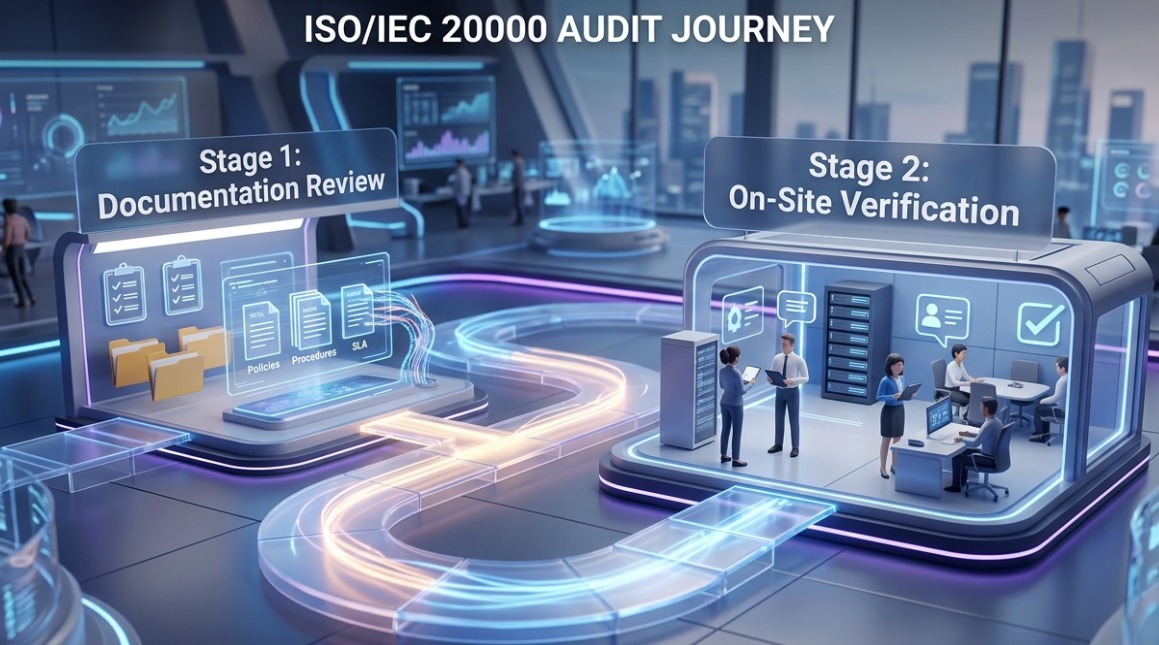
Stage 1 and Stage 2 Audits
Before the auditor arrives, your team needs to compile three months of continuous ticket data showing zero gaps in your change management records. The formal iso 20000 certification audit is executed in two distinct, sequential phases designed to minimize sudden surprises.
Stage 1 Audit (Documentation Review): The auditor reviews your written policies, SMS processes, and scope definitions. If your documentation misses a core requirement, you get a list of major gaps to patch before proceeding.
Stage 2 Audit (On-Site Verification): The auditor interviews your engineering teams and samples real-time incident tickets. They want to see 3 to 6 months of historical data proving that your teams actually follow the written procedures.
Surviving a comprehensive iso 20000 audit requires keeping clear log records and configuration baselines. At A&T Global IT Consulting, we actively embed ourselves in your workflow ahead of these milestones, eliminating the typical last-minute scramble.
Before allocating your quarterly budget, you need to calculate the engineering hours required to build out missing asset repositories. The total iso 20000 certification cost fluctuates based on several predictable variables:
Total Organization Headcount: The number of engineers and service desk agents interacting with your service delivery infrastructure.
Infrastructure Complexity: Managing single-region cloud setups costs less to audit than complex, hybrid legacy setups.
Internal Process Maturity: Teams with existing, mature ITIL processes require far fewer remedial consulting hours.
Registrar Pricing: Expect registrar day-rates to range between $1,500 and $2,500 per auditor day depending on the provider.
Finding an ISO 20000 Certification Consultant in the USA & Canada
Before hiring any third-party firm, demand to see case studies where they guided an MSP or IT team through a Stage 2 evaluation without major non-conformities. Successfully deploying this standard requires localized expertise that understands North American corporate compliance. Partnering with a dedicated iso 20000 certification consultant clarifies complex requirements and protects your internal engineering hours.
Whether you need an iso 20000 certification in usa tech hubs or across Canadian commercial sectors, A&T Global IT Consulting delivers hands-on audit preparation. We build practical compliance frameworks that fit cleanly alongside your existing development pipelines.
Direct Training Pathways & Course Pricing
Advanced Implementer & Auditor Tracks
Senior engineers building your actual compliance architecture need deeper tactical training to survive Stage 1 and Stage 2 reviews. Our A&T Global IT Consulting ISO/IEC 20000 Lead Implementer and Lead Auditor pathways provide these blueprints. Both advanced courses range from CAD 1,149 to CAD 2,250, with available sale discounts reducing the final cost by up to 43%.
Why PECB Certification?
Global Recognition & Portability
Well it’s because PECB Certification has recognition and is portable.When you’re buying training seats you want to make sure the credential you get is recognized internationally.PECB is a certification body that follows ISO/IEC 17024 rules.This means when your engineers pass an exam with our help their credentials are valid away in Europe, Asia and North America.
Rigorous Exam Verification
The problem with online certifications is that it’s easy for people to cheat. PECB has strict rules during exams to prevent cheating.They also have a registry to verify exam results.This way clients can easily check if your team’s credentials are real.It helps during the hiring process. When checking compliance.Your team can prove their credentials easily. It builds trust.